Class TLcdGXYArcBandPainter
- All Implemented Interfaces:
ILcdCloneable,ILcdPropertyChangeSource,ILcdGXYEditor,ILcdGXYEditorProvider,ILcdGXYPainter,ILcdGXYPainterProvider,ILcdGXYPathPainter,Serializable,Cloneable
ILcdArcBand objects and enables visual editing of
ILcd2DEditableArcBand objects in an ILcdGXYView.
Painting an ILcdArcBand
Body
This painter provides three paint modes to paint the body of an ILcdArcBand object. The mode
property can be set using the method setMode and allows the arc band to be painted
as:
| |
||||
 |
|
 |
|
 |
An outlined arc band (OUTLINED) |
|
A filled arc band (FILLED) |
|
A filled and outlined arc band (OUTLINED_FILLED) |
Objects that are selected or that are being edited, are painted as defined by the selectionMode and editMode properties, respectively. The same values as above can be used for both mode properties.
Handles
This painter defines the four corner points of the ILcdArcBand object as a handle of
the arc band. The following image clarifies the handle location, the corner points are represented
by red points.
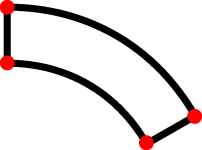
Note that the center point of the arc band is painted in
BODY mode depending on the drawCenter property. When painted, it can be used as a handle to edit the object.
Snap targets
One of the four corner points of the ILcdArcBand object can be returned on the condition
that it is touched. If the center point is painted (see isDrawCenter()) or when snapping to
invisible points is enabled (see isSnapToInvisiblePoints()), the center point can also be
returned. The point returned as a snap target is highlighted with the snapIcon.
Styling options
The visualization of the ILcdArcBand object is governed by the line style and fill style
set to this painter. Depending on the paint mode chosen one or both of these will be taken into account.
Locating an ILcdArcBand in a view
Anchor point of an ILcdArcBand
The location of the anchor point can be set using setAnchorPointLocation(int) to the
middle of the arcband's bounds or to the middle of arcband itself. By default the anchor point is
located at the center point of the bounds, calculated by boundsSFCT.
Note that the center point of the ILcdArcBand
object is not taken into account.
When is an ILcdArcBand touched
Depending on the paint mode, an arc band is touched when either the contour, one of the corner points, the center point, or the internal area (when filled) of the arc band is touched. Note that the center point can only be touched if it is painted.
Visual bounds of an ILcdArcBand
The bounds of the ILcdArcBand object contains the contour of the arc band and the center
point if it is painted.
Visually editing and creating an ILcd2DEditableArcBand
Modifying an ILcd2DEditableArcBand
This editor provides the following edit functionality for the different render modes:
RESHAPED: the arc segment or the angle line is reshaped, depending on whether they are touched. The images below illustrate the editing behavior. The small black arrow indicates the path of the mouse cursor while reshaping the arc band.
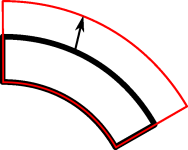
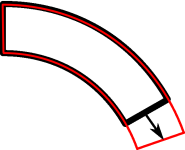
Moving an arc segment.
Moving an angle line. TRANSLATED: a corner point or the whole arc band is translated, depending on whether a corner point, the contour or the interior is touched. The images below illustrate the editing behavior. The small black arrow indicates the path of the mouse cursor while translating the arc band.
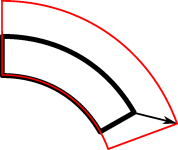
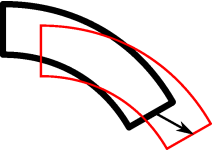
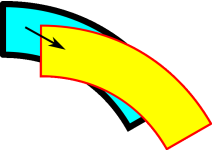
Moving a corner point.
Moving the contour.
Moving the interior.
Note that, if the center point of the arc band is touched (and painted), the whole arc band can be translated as if the contour was touched.
Creating an ILcd2DEditableArcBand
When initializing an arc band via interaction through the view, 3 user interactions are required
to complete the initialization. The first point defines the center point of the arc band, the second the start
angle and the third the width of the arc band.
The creationOrientation property defines the orientation of the arc band
during creation.
Accepted snap targets
All points are accepted as snap target as long as:
- the point can be transformed to the reference of the
ILcdArcBandobject with themodel to model transformation, - the point is not one of the snappable points of the
ILcdArcBandobject set to this painter.
Additional properties
Caching
This painter implementation supports caching for objects implementing ILcdCache.
Caching can be turned on/off with the setPaintCache method.
Drawing the center point
The drawCenter and drawCenterWhenSelected
properties define when the center point needs to be painted. If the center point is painted, it can
be touched, moved,...
- See Also:
-
Field Summary
FieldsModifier and TypeFieldDescriptionprotected static final intConstant value denoting the body of the arc band.protected static final intConstant value denoting the center point of the arc band.static final intConstant for a clockwise orientation when creating an arc band.static final intConstant for a counter clockwise orientation when creating an arc band.protected static final intConstant value denoting the end angle line of the arc band.static final intDraw theILcdArcBandobject as a filled arc band, only the area of the arc band defined by theILcdArcBandis painted.static final intConstant value indicating that the anchor point should be chosen as the focus point of the arcband.protected static final intConstant value denoting the maximum arc segment of the arc band.protected static final intConstant value denoting the corner point at the end angle and the maximum radius of the arc band.protected static final intConstant value denoting the corner point at the start angle and the maximum radius of the arc band.static final intConstant value indicating that the anchor point should be chosen in the middle of the arcband itself.static final intConstant value indicating that the anchor point should be chosen in the middle of the arcband's bounds, calculated byboundsSFCT.protected static final intConstant value denoting the minimum arc segment of the arc band.protected static final intConstant value denoting the corner point at the end angle and the minimum radius of the arc band.protected static final intConstant value denoting the corner point at the start angle and the minimum radius of the arc band.static final intDraw theILcdArcBandobject as an outlined arc band, only the contour of the arc band defined by theILcdArcBandis painted.static final intDraw theILcdArcBandobject as an outlined and filled arc band, both the area and the contour of the arc band defined by theILcdArcBandare painted.static CursorCursor to return to indicate the object will be reshaped.static Cursor[]Cursor to return to indicate the object will be reshaped.static CursorCursor to return to indicate the object will be translated.protected static final intConstant value denoting the start angle line of the arc band.Fields inherited from class com.luciad.view.gxy.ALcdGXYPainter
defaultCreationFillStyle, defaultCreationLineStyle, defaultFillStyle, defaultLineStyle, fWorkBoundsFields inherited from interface com.luciad.view.gxy.ILcdGXYEditor
CREATING, END_CREATION, RESHAPED, START_CREATION, TRANSLATEDFields inherited from interface com.luciad.view.gxy.ILcdGXYPainter
CREATING, DEFAULT, HANDLES, RESHAPING, SELECTED, SNAPS, TRANSLATING -
Constructor Summary
ConstructorsConstructorDescriptionConstructs a defaultTLcdGXYArcBandPainterand sets the display name to "Arc Band". -
Method Summary
Modifier and TypeMethodDescriptionbooleanacceptSnapTarget(Graphics aGraphics, ILcdGXYContext aGXYContext) Determines whether a snap target should be accepted or not.voidanchorPointSFCT(Graphics aGraphics, int aRenderMode, ILcdGXYContext aGXYContext, Point aPointSFCT) Moves the specifiedaPointSFCTto the anchor point of theILcdArcBandobjectbooleanappendAWTPath(ILcdGXYContext aGXYContext, int aRenderMode, ILcdAWTPath aAWTPathSFCT) Appends a discretized representation in view coordinates to the given path.booleanappendGeneralPath(ILcdGXYContext aGXYContext, int aRenderMode, ILcdGeneralPath aGeneralPathSFCT) Appends a discretized representation in world coordinates to the given path.protected voidboundsOfEditingLabelsSFCT(Graphics aGraphics, ILcdArcBand aArcBand, int aTouchedLocation, ILcdGXYContext aGXYContext, ILcd2DEditableBounds aBoundsSFCT) Called by theboundsSFCTmethod when editing anILcd2DEditableArcBand.voidboundsSFCT(Graphics aGraphics, int aRenderMode, ILcdGXYContext aGXYContext, ILcd2DEditableBounds aBoundsSFCT) Computes the bounds of the representation of anILcdArcBandin AWT coordinates.clone()MakesObject.clone()public.booleanedit(Graphics aGraphics, int aRenderMode, ILcdGXYContext aGXYContext) This implementation edits theILcdArcBandobject set to the painter.intReturns the location of the anchor point (by default: MIDDLE_OF_BOUNDS).Returns the icon for the center point's default representation, used ifisDrawCenter()returns true.Returns the icon for the center point's selected representation, used ifisDrawCenterWhenSelected()returns true.intReturns3as the number of required user interactions.intReturns the orientation used while creatingILcdArcBandobjects.getCursor(Graphics aGraphics, int aRenderMode, ILcdGXYContext aGXYContext) Returns aCursorthat clarifies the render mode and context this painter is operating in.getGXYEditor(Object aObject) Returns this instance as editor for editing the specifiedObject.intReturns the minimum pixel distance the input device (a mouse, for example) must move before editing the shape.final ObjectReturns the object that can currently be painted or edited by this painter/editor.booleanReturns whether caching is used when painting this painter's object.Returns the icon that is used to paint snap target points of the object set to this painter.booleanDeprecated.booleanReturns whether the center point of the arc band should be displayed.booleanReturns whether the center point of the arc band should be displayed when it is painted in selected mode.booleanReturns whether the painter allows snapping to the invisible points of the shape.booleanisTouched(Graphics aGraphics, int aRenderMode, ILcdGXYContext aGXYContext) Depending on the rendering mode, returns whether one or more of the contour, the corner points, the center point, or the interior of the arc band is touched.booleanDeprecated.This method has been deprecated.voidpaint(Graphics aGraphics, int aRenderMode, ILcdGXYContext aGXYContext) Displays the representation of the object in the given mode on the Graphics passed, taking into account the context passed.protected voidpaintEditingLabels(Graphics aGraphics, ILcdArcBand aArcBand, int aTouchedLocation, ILcdGXYContext aGXYContext) Called by thepaintmethod when editing anILcd2DEditableArcBand.voidsetAnchorPointLocation(int aAnchorPointLocation) Sets the preferred anchor point location.voidsetAnglesFormat(Format aAnglesFormat) Sets the format that will be used when displaying the angles of theILcdArcBandwhile the angles are being edited.voidsetCenterIcon(ILcdIcon aIcon) Sets the icon for the center point's default representation, ifisDrawCenter()returns true.voidSets the icon for the center point's selected representation, ifisDrawCenterWhenSelected()returns true.voidsetCenterPointFormat(Format aCenterPointFormat) Sets the format that will be used when displaying the center point while theILcdArcBandobject is being moved.voidsetCreateCounterClockwise(boolean aCreateCounterClockwise) Deprecated.Use the methodsetCreationOrientation(int).voidsetCreationOrientation(int aCreationOrientation) Sets the orientation used while creatingILcdArcBandobjects.voidsetDrawCenter(boolean aDrawCenter) Sets whether the center point of the arc band should be displayed or not.voidsetDrawCenterWhenSelected(boolean aDrawCenterWhenSelected) Sets whether the center point of the arc band should be displayed when it is painted in selected mode or not.voidsetMaxRadiusFormat(Format aMaxRadiusFormat) Sets the format that will be used when displaying the maximum radius of theILcdArcBandwhile the maximum radius is being edited.voidsetMinimumEditDelta(int aDelta) Sets the minimum pixel distance the input device (a mouse, for example) must move before editing the shape.voidsetMinRadiusFormat(Format aMinRadiusFormat) Sets the format that will be used when displaying the minimum radius of theILcdArcBandwhile the minimum radius is being edited.voidsetMode(int aDefaultMode) Sets the default mode to decide how to paint anILcdArcBandobject.voidsetModelModelTransformationClass(Class aModel2ModelTransformationClass) Sets the transformation class that should be used when snapping to points that are defined in a different reference than the reference of this painter's object.voidSets the object to paint and edit.voidsetPaintCache(boolean aPaintCache) Turns caching of the representation of the object on or off.voidsetSnapIcon(ILcdIcon aSnapIcon) Sets the icon that marks snap targets of the object currently set to this painter.voidsetSnapToInvisiblePoints(boolean aSnapToInvisiblePoints) Sets whether the other shapes can snap to invisible points of this shape.voidsetTraceOn(boolean aTraceOn) Deprecated.This method has been deprecated.protected voidsetupGraphicsForFill(Graphics aGraphics, int aRenderMode, ILcdGXYContext aGXYContext) Called just before filling arc bands on the specifiedGraphicsobject.protected voidsetupGraphicsForLine(Graphics aGraphics, Object aObject, int aRenderMode, ILcdGXYContext aGXYContext) Called just before painting a line on the specifiedGraphicsobject.snapTarget(Graphics aGraphics, ILcdGXYContext aGXYContext) Returns the center point or one of the end points of theILcdArcBandif it is touched.booleansupportSnap(Graphics aGraphics, ILcdGXYContext aGXYContext) This implementation supports snapping, always returnstrue.Methods inherited from class com.luciad.view.gxy.painter.ALcdGXYAreaPainter
getEditMode, getFillStyle, getLineStyle, getMode, getSelectionMode, setEditMode, setFillStyle, setLineStyle, setSelectionModeMethods inherited from class com.luciad.view.gxy.ALcdGXYPainter
addPropertyChangeListener, firePropertyChangeEvent, firePropertyChangeEvent, getDisplayName, getGXYPainter, removePropertyChangeListener, setClassTraceOn, setDisplayNameMethods inherited from class java.lang.Object
equals, finalize, getClass, hashCode, notify, notifyAll, toString, wait, wait, waitMethods inherited from interface com.luciad.view.gxy.ILcdGXYEditor
getDisplayNameMethods inherited from interface com.luciad.view.gxy.ILcdGXYPainter
getDisplayNameMethods inherited from interface com.luciad.util.ILcdPropertyChangeSource
addPropertyChangeListener, removePropertyChangeListener
-
Field Details
-
OUTLINED
public static final int OUTLINEDDraw theILcdArcBandobject as an outlined arc band, only the contour of the arc band defined by theILcdArcBandis painted.- See Also:
-
FILLED
public static final int FILLEDDraw theILcdArcBandobject as a filled arc band, only the area of the arc band defined by theILcdArcBandis painted.- See Also:
-
OUTLINED_FILLED
public static final int OUTLINED_FILLEDDraw theILcdArcBandobject as an outlined and filled arc band, both the area and the contour of the arc band defined by theILcdArcBandare painted.- See Also:
-
CENTER
protected static final int CENTERConstant value denoting the center point of the arc band.- See Also:
-
BODY
protected static final int BODYConstant value denoting the body of the arc band.- See Also:
-
MIN_RADIUS_ARC
protected static final int MIN_RADIUS_ARCConstant value denoting the minimum arc segment of the arc band.- See Also:
-
MAX_RADIUS_ARC
protected static final int MAX_RADIUS_ARCConstant value denoting the maximum arc segment of the arc band.- See Also:
-
START_ANGLE_LINE
protected static final int START_ANGLE_LINEConstant value denoting the start angle line of the arc band.- See Also:
-
END_ANGLE_LINE
protected static final int END_ANGLE_LINEConstant value denoting the end angle line of the arc band.- See Also:
-
MIN_RADIUS_START_CORNER
protected static final int MIN_RADIUS_START_CORNERConstant value denoting the corner point at the start angle and the minimum radius of the arc band.- See Also:
-
MAX_RADIUS_START_CORNER
protected static final int MAX_RADIUS_START_CORNERConstant value denoting the corner point at the start angle and the maximum radius of the arc band.- See Also:
-
MIN_RADIUS_END_CORNER
protected static final int MIN_RADIUS_END_CORNERConstant value denoting the corner point at the end angle and the minimum radius of the arc band.- See Also:
-
MAX_RADIUS_END_CORNER
protected static final int MAX_RADIUS_END_CORNERConstant value denoting the corner point at the end angle and the maximum radius of the arc band.- See Also:
-
sCursorTranslating
Cursor to return to indicate the object will be translated. -
sCursorReshaping
Cursor to return to indicate the object will be reshaped. -
sCursorResizing
Cursor to return to indicate the object will be reshaped. Direction depends on the shape of the object. -
CLOCKWISE
public static final int CLOCKWISEConstant for a clockwise orientation when creating an arc band.- See Also:
-
COUNTERCLOCKWISE
public static final int COUNTERCLOCKWISEConstant for a counter clockwise orientation when creating an arc band.- See Also:
-
MIDDLE_OF_BOUNDS
public static final int MIDDLE_OF_BOUNDSConstant value indicating that the anchor point should be chosen in the middle of the arcband's bounds, calculated byboundsSFCT. Note that the center point of theILcdArcBandobject is not taken into account.- See Also:
-
FOCUS_POINT
public static final int FOCUS_POINTConstant value indicating that the anchor point should be chosen as the focus point of the arcband. If this point cannot be calculated, theMIDDLE_OF_BOUNDSmethod is used to calculate the anchor point.- See Also:
-
MIDDLE_OF_ARCBAND
public static final int MIDDLE_OF_ARCBANDConstant value indicating that the anchor point should be chosen in the middle of the arcband itself.- See Also:
-
-
Constructor Details
-
TLcdGXYArcBandPainter
public TLcdGXYArcBandPainter()Constructs a defaultTLcdGXYArcBandPainterand sets the display name to "Arc Band".
-
-
Method Details
-
setTraceOn
public void setTraceOn(boolean aTraceOn) Deprecated.This method has been deprecated. It is recommended to use the standard Java logging framework directly.Enables tracing for this class instance. Calling this method with eithertrueorfalseas argument automatically turns off tracing for all other class instances for whichsetTraceOnhas not been called. If the argument isfalsethen only the informative, warning and error log messages are recorded.- Overrides:
setTraceOnin classALcdGXYPainter- Parameters:
aTraceOn- if true then all log messages are recorded for this instance. If false, then only the informative, warning and error log messages are recorded.
-
isTraceOn
public boolean isTraceOn()Deprecated.This method has been deprecated. It is recommended to use the standard Java logging framework directly.Returnstrueif tracing is enabled for this class.- Overrides:
isTraceOnin classALcdGXYPainter- Returns:
- true if tracing is enabled for this class, false otherwise.
-
setObject
Sets the object to paint and edit. The object should be an instance of
ILcdArcBandfor painting and an instance ofILcd2DEditableArcBandfor editing.This painter/editor can be used to paint the object without using the edit functionality. This method shall therefore only check if the object implements
ILcdArcBandand shall throw aClassCastExceptionif it does not.When this painter is used as editor with an object that does not implement the interface
ILcd2DEditableArcBand, theeditmethod shall throw the necessary exception.- Specified by:
setObjectin interfaceILcdGXYEditor- Specified by:
setObjectin interfaceILcdGXYPainter- Parameters:
aObject- The object to paint and edit.- Throws:
ClassCastException- when the object does not implementILcdArcBand.- See Also:
-
getObject
Returns the object that can currently be painted or edited by this painter/editor.- Specified by:
getObjectin interfaceILcdGXYEditor- Specified by:
getObjectin interfaceILcdGXYPainter- Returns:
- the object that can currently be painted or edited by this painter/editor.
- See Also:
-
setPaintCache
public void setPaintCache(boolean aPaintCache) Turns caching of the representation of the object on or off. Caching greatly reduces the time to paint an object but requires more memory. The representation of an object can only be cached for objects which implementILcdCache. By default, caching is turned on.- Parameters:
aPaintCache- A flag indicating whether to use caching when painting an object.- See Also:
-
getPaintCache
public boolean getPaintCache()Returns whether caching is used when painting this painter's object.- Returns:
trueif caching is used to paint this painter's object,falseotherwise.- See Also:
-
setCreateCounterClockwise
public void setCreateCounterClockwise(boolean aCreateCounterClockwise) Deprecated.Use the methodsetCreationOrientation(int). Note that this method will fire two property change events for backward compatibility.Sets whether theILcdArcBandshould be initialized with a preference for counter clockwise arcs.- Parameters:
aCreateCounterClockwise- A flag indicating whether theILcdArcBandshould be initialized with a preference for counter clockwise arcs.- See Also:
-
isCreateCounterClockwise
public boolean isCreateCounterClockwise()Deprecated.Returns whether theILcdArcBandshould be created with a preference for counter clockwise arcs.- Returns:
- whether the
ILcdArcBandshould be created with a preference for counter clockwise arcs. - See Also:
-
setCreationOrientation
public void setCreationOrientation(int aCreationOrientation) Sets the orientation used while creatingILcdArcBandobjects. The value passed should beCLOCKWISEorCOUNTERCLOCKWISE. The default value isCOUNTERCLOCKWISEfor backward compatibility reasons.- Parameters:
aCreationOrientation- A flag indicating the orientation of the arc band during creation.- See Also:
-
getCreationOrientation
public int getCreationOrientation()Returns the orientation used while creatingILcdArcBandobjects.- Returns:
- the orientation used while creating
ILcdArcBandobjects. - See Also:
-
setMode
public void setMode(int aDefaultMode) Sets the default mode to decide how to paint an
ILcdArcBandobject. The object can be painted as an outlined arc band (OUTLINED), as a filled arc band (FILLED), or as a filled and outlined arc band (OUTLINED_FILLED).As a side effect, this method will set the display name and initialize the line style if no line style was defined. The used display name are respectively "OutlinedArcBand", "FilledArcBand", "OutlinedFilledArcBand".
- Overrides:
setModein classALcdGXYAreaPainter- Parameters:
aDefaultMode- The default paint mode to paintILcdArcBandobjects.- See Also:
-
setDrawCenter
public void setDrawCenter(boolean aDrawCenter) Sets whether the center point of the arc band should be displayed or not. The default value of this property isfalse. This setting has an influence on the methodsboundsSFCT,isTouchedand snapping. Regardless of this setting, the center point is always displayed as a handle in HANDLES mode to allow editing.- Parameters:
aDrawCenter- A flag indicating whether the center point should be displayed or not.- See Also:
-
isDrawCenter
public boolean isDrawCenter()Returns whether the center point of the arc band should be displayed.- Returns:
- whether the center point of the arc band should be displayed.
- See Also:
-
setDrawCenterWhenSelected
public void setDrawCenterWhenSelected(boolean aDrawCenterWhenSelected) Sets whether the center point of the arc band should be displayed when it is painted in selected mode or not. The default value of this property istrue. This setting has an influence on the methodsboundsSFCT,isTouchedand snapping. Regardless of this setting, the center point is always displayed as a handle in HANDLES mode to allow editing.- Parameters:
aDrawCenterWhenSelected- A flag indicating whether the center point should be displayed when it is painted in selected mode or not.- See Also:
-
isDrawCenterWhenSelected
public boolean isDrawCenterWhenSelected()Returns whether the center point of the arc band should be displayed when it is painted in selected mode.- Returns:
- whether the center point of the arc band should be displayed when it is painted in selected mode.
- See Also:
-
setCenterIcon
Sets the icon for the center point's default representation, ifisDrawCenter()returns true.- Parameters:
aIcon- the icon for the center point's default representation- See Also:
-
getCenterIcon
Returns the icon for the center point's default representation, used ifisDrawCenter()returns true.- Returns:
- the icon for the center point's default representation
-
setCenterIconWhenSelected
Sets the icon for the center point's selected representation, ifisDrawCenterWhenSelected()returns true.- Parameters:
aIcon- the icon for the center point's selected representation- See Also:
-
getCenterIconWhenSelected
Returns the icon for the center point's selected representation, used ifisDrawCenterWhenSelected()returns true.- Returns:
- the icon for the center point's selected representation
-
setCenterPointFormat
Sets the format that will be used when displaying the center point while theILcdArcBandobject is being moved.- Parameters:
aCenterPointFormat- TheFormatused to display the center point information.
-
setAnglesFormat
Sets the format that will be used when displaying the angles of theILcdArcBandwhile the angles are being edited.- Parameters:
aAnglesFormat- TheFormatused to display the angle information.
-
setMinRadiusFormat
Sets the format that will be used when displaying the minimum radius of theILcdArcBandwhile the minimum radius is being edited.- Parameters:
aMinRadiusFormat- TheFormatused to display the minimum radius information.
-
setMaxRadiusFormat
Sets the format that will be used when displaying the maximum radius of theILcdArcBandwhile the maximum radius is being edited.- Parameters:
aMaxRadiusFormat- TheFormatused to display the maximum radius information.
-
setSnapToInvisiblePoints
public void setSnapToInvisiblePoints(boolean aSnapToInvisiblePoints) Sets whether the other shapes can snap to invisible points of this shape. For anILcdArcBandobject, there's only one invisible point, being the center point of the arc band when it is not drawn. The default value isfalse.- Parameters:
aSnapToInvisiblePoints- A flag indicating whether snapping to the invisible points is allowed.- See Also:
-
isSnapToInvisiblePoints
public boolean isSnapToInvisiblePoints()Returns whether the painter allows snapping to the invisible points of the shape.- Returns:
- whether the painter allows snapping to the invisible points of the shape.
- See Also:
-
setMinimumEditDelta
public void setMinimumEditDelta(int aDelta) Sets the minimum pixel distance the input device (a mouse, for example) must move before editing the shape. A larger value ensures that the object easily "snaps" back in place, a small value allows fine editing.- Parameters:
aDelta- the minimum pixel distance the input device should move in either the X or Y direction
-
getMinimumEditDelta
public int getMinimumEditDelta()Returns the minimum pixel distance the input device (a mouse, for example) must move before editing the shape. A larger value ensures that the object easily "snaps" back in place, a small value allows fine editing. The default value is 3 pixels.- Returns:
- the minimum pixel distance the input device should move in either the X or Y direction
-
setSnapIcon
Sets the icon that marks snap targets of the object currently set to this painter. This icon is painted when thepaintmethod is called with the render modeILcdGXYPainter.SNAPS.- Parameters:
aSnapIcon- The icon that should be used to paint snap target points.- See Also:
-
getSnapIcon
Returns the icon that is used to paint snap target points of the object set to this painter.- Returns:
- the icon that is used to paint snap target points of the object set to this painter.
- See Also:
-
getAnchorPointLocation
public int getAnchorPointLocation()Returns the location of the anchor point (by default: MIDDLE_OF_BOUNDS).- Returns:
- one of
MIDDLE_OF_BOUNDS,FOCUS_POINT,MIDDLE_OF_ARCBAND
-
setAnchorPointLocation
public void setAnchorPointLocation(int aAnchorPointLocation) Sets the preferred anchor point location.- Parameters:
aAnchorPointLocation- one ofMIDDLE_OF_BOUNDS,FOCUS_POINT,MIDDLE_OF_ARCBAND
-
setupGraphicsForLine
protected void setupGraphicsForLine(Graphics aGraphics, Object aObject, int aRenderMode, ILcdGXYContext aGXYContext) Called just before painting a line on the specified
Graphicsobject. It can be redefined in order to set specificGraphicsproperties likeColor, etc...This implementation calls
ILcdGXYPainterStyle.setupGraphics(java.awt.Graphics, java.lang.Object, int, com.luciad.view.gxy.ILcdGXYContext)on the lineStyle property if a line style has been set to this instance.- Parameters:
aGraphics- The graphics to paint the object on.aObject- The object to paint.aRenderMode- The mode to render the object in.aGXYContext- The context to render the object in.
-
setupGraphicsForFill
protected void setupGraphicsForFill(Graphics aGraphics, int aRenderMode, ILcdGXYContext aGXYContext) Called just before filling arc bands on the specified
Graphicsobject. It can be redefined in order to set specificGraphicsproperties likeColor, etc...This implementation calls
ILcdGXYPainterStyle.setupGraphics(java.awt.Graphics, java.lang.Object, int, com.luciad.view.gxy.ILcdGXYContext)on the fillStyle property if a fill style has been set to this instance.- Parameters:
aGraphics- The graphics to paint the object on.aRenderMode- The mode to render the object in.aGXYContext- The context to render the object in.
-
paint
Displays the representation of the object in the given mode on the Graphics passed, taking into account the context passed.This implementation will use the specified render mode to determine how the object needs to be rendered. In
ILcdGXYPainter.CREATING,ILcdGXYPainter.RESHAPINGandILcdGXYPainter.TRANSLATINGmode, the object is painted using the edit paint mode (ALcdGXYAreaPainter.getEditMode()). The object is rendered as shown in the images of the class documentation.In the render mode
ILcdGXYPainter.SELECTED, the object is painted using the selection paint mode (ALcdGXYAreaPainter.getSelectionMode()). In all other render modes, the paint mode (ALcdGXYAreaPainter.getMode()) is used.- Specified by:
paintin interfaceILcdGXYPainter- Parameters:
aGraphics- The graphics to paint the object on.aRenderMode- The mode to render the object in.aGXYContext- The context to render the object in.
-
appendAWTPath
Description copied from interface:ILcdGXYPathPainterAppends a discretized representation in view coordinates to the given path.- Specified by:
appendAWTPathin interfaceILcdGXYPathPainter- Parameters:
aGXYContext- the graphics contextaRenderMode- the rendering modeaAWTPathSFCT- the path to append to- Returns:
- true if a discretization of the shape could be successfully appended to the path
-
appendGeneralPath
public boolean appendGeneralPath(ILcdGXYContext aGXYContext, int aRenderMode, ILcdGeneralPath aGeneralPathSFCT) Description copied from interface:ILcdGXYPathPainterAppends a discretized representation in world coordinates to the given path.- Specified by:
appendGeneralPathin interfaceILcdGXYPathPainter- Parameters:
aGXYContext- the graphics contextaRenderMode- the rendering modeaGeneralPathSFCT- the path to append to- Returns:
- true if a discretization of the shape could be successfully appended to the path
-
paintEditingLabels
protected void paintEditingLabels(Graphics aGraphics, ILcdArcBand aArcBand, int aTouchedLocation, ILcdGXYContext aGXYContext) Called by the
paintmethod when editing anILcd2DEditableArcBand. It draws labels indicating the values of properties being changed. For example, the coordinates of the center point of the arc band, the minimum or maximum radius, the start angle, etc ... This method draws the default labels but it can be redefined for specific needs.The
aTouchedLocationargument indicates which part of the arc band is being edited. For example,MAX_RADIUS_START_CORNERcorresponds to the corner point at the start angle and the maximum radius of the arc band. It should be one of the following constants:CENTER,MIN_RADIUS_ARC,MAX_RADIUS_ARC,MIN_RADIUS_START_CORNER,MAX_RADIUS_START_CORNER,MIN_RADIUS_END_CORNER,MAX_RADIUS_END_CORNER- Parameters:
aGraphics- The graphics to paint the object on.aArcBand- The arc band that is being edited.aTouchedLocation- The part of the arc band that is being edited.aGXYContext- The context to render the object in.
-
boundsSFCT
public void boundsSFCT(Graphics aGraphics, int aRenderMode, ILcdGXYContext aGXYContext, ILcd2DEditableBounds aBoundsSFCT) throws TLcdNoBoundsException Computes the bounds of the representation of anILcdArcBandin AWT coordinates. The bounds will include the center point of the arc band depending on whether it is rendered or not. This in turn depends on the painter mode passed and the values of the propertiesdrawCenteranddrawCenterWhenSelected.- Specified by:
boundsSFCTin interfaceILcdGXYPainter- Parameters:
aGraphics- The graphics to paint the object on.aRenderMode- The mode to render the object in.aGXYContext- The context to render the object in.aBoundsSFCT- The bounds to update.- Throws:
TLcdNoBoundsException- if no bounds can be determined for the representation of the object. This can be when the object does not have a representation in the given context, for example when it is located in a part of the world which is not visible in the projection as set in the views world reference.- See Also:
-
boundsOfEditingLabelsSFCT
protected void boundsOfEditingLabelsSFCT(Graphics aGraphics, ILcdArcBand aArcBand, int aTouchedLocation, ILcdGXYContext aGXYContext, ILcd2DEditableBounds aBoundsSFCT) Called by the
boundsSFCTmethod when editing anILcd2DEditableArcBand. It calculates the bounds of the labels indicating the values of properties being changed. For example, the coordinates of the center point of the arc band, the minimum or maximum radius, the start angle, etc ...Note that the
ILcd2DEditableBoundsobject already contains the bounds of the edited object. Upon exit of this method, this object should be set to the union of the bounds of the edited object and the labels painted while editing.The
aTouchedLocationargument indicates which part of the arc band is being edited. For example,MAX_RADIUS_START_CORNERcorresponds to the corner point at the start angle and the maximum radius of the arc band. It should be one of the following constants:CENTER,MIN_RADIUS_ARC,MAX_RADIUS_ARC,MIN_RADIUS_START_CORNER,MAX_RADIUS_START_CORNER,MIN_RADIUS_END_CORNER,MAX_RADIUS_END_CORNER- Parameters:
aGraphics- The graphics to paint the object on.aArcBand- The arc band that is being edited.aTouchedLocation- The part of the arc band that is being edited.aGXYContext- The context to render the object in.aBoundsSFCT- The bounds in view coordinates to be updated.
-
isTouched
Depending on the rendering mode, returns whether one or more of the contour, the corner points, the center point, or the interior of the arc band is touched. Note that the center point can only be touched if it is painted.This implementation will use the specified
paint modeto determine how the object is represented. Depending on the representation of theILcdArcBandobject, the object is touched if the contour, one of its corner points, the center point (when painted) or, its interior space (when it is painted filled) is touched. The coordinate for which the check is done is derived from the context passed as argument.- Specified by:
isTouchedin interfaceILcdGXYPainter- Parameters:
aGraphics- The graphics to paint the object on.aRenderMode- The mode to render the object in, a combination of the constants in ILcdGXYPainter.aGXYContext- The context in which the object is rendered.- Returns:
- the contour, the corner points, the center point, or the interior of the arc band is touched.
- See Also:
-
getCursor
Returns aCursorthat clarifies the render mode and context this painter is operating in. When no specificCursoris required,nullis returned.- Specified by:
getCursorin interfaceILcdGXYPainter- Overrides:
getCursorin classALcdGXYPainter- Parameters:
aGraphics- The graphics on which the object is painted.aRenderMode- The mode to render the object in.aGXYContext- The context in which the object is rendered.- Returns:
- a cursor to indicate the type of operating mode and context. Returns
nullif no particular cursor is required.
-
getGXYEditor
Returns this instance as editor for editing the specifiedObject. If thisObjectis not the same as theObjectset to this painter, thesetObject(Object)method is called to update the object set to the painter.- Specified by:
getGXYEditorin interfaceILcdGXYEditorProvider- Parameters:
aObject- the object to be edited.- Returns:
- this instance as editor for editing the specified
Object.
-
edit
This implementation edits the
ILcdArcBandobject set to the painter. The object needs to implement the interfaceILcd2DEditableArcBandotherwise aClassCastExceptionwill be thrown.In
ILcdGXYEditor.TRANSLATEDrender mode, theILcdArcBandobject is edited as follows:- While touching a corner point, the corner point gets translated.
- While touching the center point, the object gets translated as a whole.
- While touching the contour, the object gets translated as a whole.
- While touching the interior and the selected object is painted as filled, the object gets translated as a whole.
In
ILcdGXYEditor.RESHAPEDrender mode, theILcdArcBandobject is edited as follows:- While touching an arc segment, the arc segment will move while enlarging or reducing the width of the arc band.
- While touching an angle line, the angle line will move while enlarging or reducing the arc angle of the arc band.
In the creation render modes, the first action defines the center point of the arc band, the second the start angle and the third the width of the arc band.
If, in all render modes, a snap target is found for a moved or created point, the snap target location is used for the moved/created point.
- Specified by:
editin interfaceILcdGXYEditor- Parameters:
aGraphics- The graphics to edit the object on.aRenderMode- The mode to render the object in.aGXYContext- The context to render the object in.- Returns:
- true if the object has changed when this method returns, false otherwise.
- Throws:
ClassCastException- if the painter's object does not implementILcd2DEditableArcBand.- See Also:
-
getCreationClickCount
public int getCreationClickCount()Returns3as the number of required user interactions.- Specified by:
getCreationClickCountin interfaceILcdGXYEditor- Returns:
3.
-
setModelModelTransformationClass
Sets the transformation class that should be used when snapping to points that are defined in a different reference than the reference of this painter's object. The transformation will be instantiated and setup to transform points from the model of the snap layer to points in the model which contains the current object of this painter. The default value is the
TLcdGeoReference2GeoReferenceclass.This property allows the painter to snap to points defined in a different model reference.
Instances of this specified class should implement
ILcdModelModelTransformation, otherwise the snapping functionality to different model references will not work.- Parameters:
aModel2ModelTransformationClass- the transformation used as described above.
-
acceptSnapTarget
Determines whether a snap target should be accepted or not. A snap target is accepted if the following conditions are met:
- The current object is an
ILcd2DEditableArcBand. - The snap target is an
ILcdPointwhose coordinates are expressed in the same coordinate system as the current objects coordinate system or the model to model transformation can transform the point to a point in the objects coordinate system. - The snap object is not one of the snappable points of the current object. If this is wanted, override the function and return true if the snap object is one of the snappable points.
- One of the corner points or the center point is touched or both minimum and maximum
radius are
0. This enables snapping when creating an arc band.
- Specified by:
acceptSnapTargetin interfaceILcdGXYEditor- Parameters:
aGraphics- the graphics on which the snap target should be checked.aGXYContext- the context in which the snap target should be checked.- Returns:
trueif the above conditions are met,falseotherwise.- See Also:
- The current object is an
-
snapTarget
Returns the center point or one of the end points of the
ILcdArcBandif it is touched. If no point was touched,nullwill be returned. Note that the center point is only returned if the center point is drawn (seeisDrawCenter()) or when snapping to invisible points is enabled (seeisSnapToInvisiblePoints()).- Specified by:
snapTargetin interfaceILcdGXYPainter- Overrides:
snapTargetin classALcdGXYPainter- Parameters:
aGraphics- the graphics on which is worked.aGXYContext- the context of the snapping.- Returns:
- the center point or one of the end points of the
ILcdArcBandif it is touched,nullotherwise. - See Also:
-
supportSnap
This implementation supports snapping, always returnstrue.- Specified by:
supportSnapin interfaceILcdGXYPainter- Overrides:
supportSnapin classALcdGXYPainter- Parameters:
aGraphics- the graphics on which is worked.aGXYContext- the context of the snapping.- Returns:
true.
-
anchorPointSFCT
public void anchorPointSFCT(Graphics aGraphics, int aRenderMode, ILcdGXYContext aGXYContext, Point aPointSFCT) throws TLcdNoBoundsException Moves the specified
aPointSFCTto the anchor point of theILcdArcBandobject- Specified by:
anchorPointSFCTin interfaceILcdGXYPainter- Overrides:
anchorPointSFCTin classALcdGXYPainter- Parameters:
aGraphics- The graphics to paint the object on.aRenderMode- The mode to render the object in.aGXYContext- The context to render the object in.aPointSFCT- The point that needs to be updated.- Throws:
TLcdNoBoundsException- if theILcdArcBandobject doesn't have a valid anchor point, e.g. if it is always invisible in the current projection.- See Also:
-
clone
Description copied from interface:ILcdCloneableMakes
When for example extending fromObject.clone()public.java.lang.Object, it can be implemented like this:public Object clone() { try { return super.clone(); } catch ( CloneNotSupportedException e ) { // Cannot happen: extends from Object and implements Cloneable (see also Object.clone) throw new RuntimeException( e ); } }- Specified by:
clonein interfaceILcdCloneable- Specified by:
clonein interfaceILcdGXYEditorProvider- Specified by:
clonein interfaceILcdGXYPainterProvider- Overrides:
clonein classALcdGXYAreaPainter- Returns:
- a clone of this painter provider.
- See Also:
-
getCreationOrientation().