Class AmbientOcclusionEffect

java.lang.Object
com.luciad.maps.effects.AmbientOcclusionEffect
All Implemented Interfaces:
AutoCloseable

public final class AmbientOcclusionEffect extends Object implements AutoCloseable
This class implements the Ambient occlusion effect, which shades areas of 3D geometry based on their proximity to other 3D geometry.

This mimics a behavior of the real world where light gets trapped in tight areas. Typical examples are the corners of a room, which are slightly darker than the rest of the room as the light is trapped in the corners.
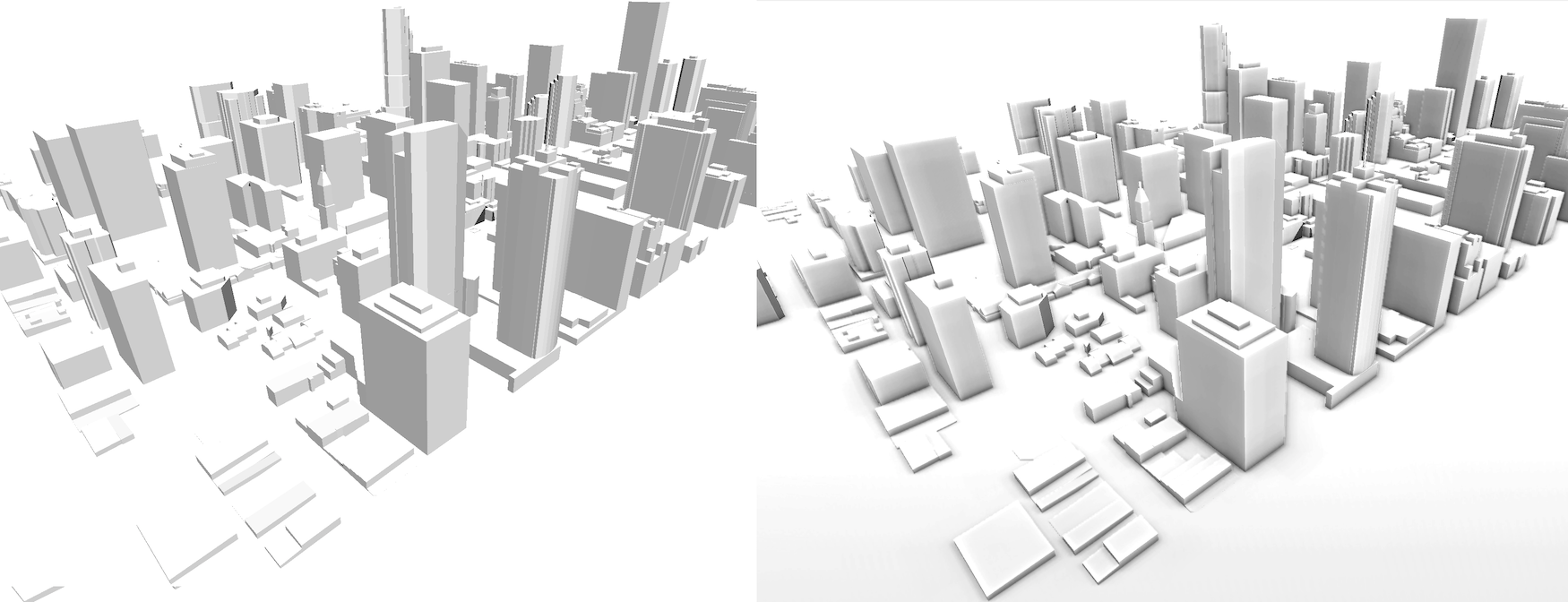
Left: ambient occlusion disabled, Right: ambient occlusion enabled

Ambient Occlusion is recommended for cases in which 3D datasets with simple colors, such as 3D CAD & BIM models, are visualized. For these types of datasets, Ambient Occlusion can help give the dataset more depth and make it easier to understand how geometry relates to each other. On top of that, it also improves the visual quality of such datasets, and gives an overall better impression.

Note that Ambient Occlusion is only applied in 3D views.

You cannot create an AmbientOcclusionEffect. Instead, you can retrieve it from GraphicsEffects#getAmbientOcclusion.

  • Method Summary

    Modifier and Type
    Method
    Description
    void
     
    protected void
     
    Returns the performance hint that indicates if Ambient Occlusion should prioritize quality or speed.
    double
    Returns the power factor which determines how strongly the effect is applied to the view.
    double
    Returns the radius in meters at which the effect is sampled.
    boolean
    Returns whether the Ambient Occlusion effect is enabled.
    void
    set(double radius, double power)
    Sets the radius and power values for the ambient occlusion effect.
    void
    set(double radius, double power, PerformanceHint performanceHint)
    Sets the radius and power values for the ambient occlusion effect.
    void
    setEnabled(boolean enabled)
    Sets whether the Ambient Occlusion effect is enabled.
    void
    Sets the performance hint that indicates if Ambient Occlusion should prioritize quality or speed.
    void
    setPower(double power)
    Sets the power factor which determines how strongly the effect is applied to the view.
    void
    setRadius(double radius)
    Sets the radius in meters at which the effect is sampled.

    Methods inherited from class java.lang.Object

    clone, equals, getClass, hashCode, notify, notifyAll, toString, wait, wait, wait
  • Method Details

    • finalize

      protected void finalize()
      Overrides:
      finalize in class Object
    • close

      public void close()
      Specified by:
      close in interface AutoCloseable
    • isEnabled

      public boolean isEnabled()
      Returns whether the Ambient Occlusion effect is enabled.
      Returns:
      whether the Ambient Occlusion effect is enabled.
    • setEnabled

      public void setEnabled(boolean enabled)
      Sets whether the Ambient Occlusion effect is enabled.

      The default is false.

      Parameters:
      enabled - true to enable the Ambient Occlusion effect or false to disable it.
    • getRadius

      public double getRadius()
      Returns the radius in meters at which the effect is sampled.
      Returns:
      the radius in meters at which the effect is sampled.
    • setRadius

      public void setRadius(double radius)
      Sets the radius in meters at which the effect is sampled.

      A lower value produces sharper results, while higher values produce softer results.

      The default radius is 30m.

      Parameters:
      radius - radius in meters at which the effect should be sampled.
    • getPower

      public double getPower()
      Returns the power factor which determines how strongly the effect is applied to the view.
      Returns:
      the power factor which determines how strongly the effect is applied to the view.
    • setPower

      public void setPower(double power)
      Sets the power factor which determines how strongly the effect is applied to the view.

      The power factor determines how much to brighten or darken the effect.

      Values should be a positive floating point number, generally between 0 and 5. Higher values are accepted, but not recommended.

      The default power value is 1.

      Parameters:
      power - factor to brighten or darken the effect.
    • getPerformanceHint

      @NotNull public PerformanceHint getPerformanceHint()
      Returns the performance hint that indicates if Ambient Occlusion should prioritize quality or speed.
      Returns:
      the performance hint that indicates if Ambient Occlusion should prioritize quality or speed.
      Since:
      2026.0.04
    • setPerformanceHint

      public void setPerformanceHint(@NotNull PerformanceHint performanceHint)
      Sets the performance hint that indicates if Ambient Occlusion should prioritize quality or speed.

      Performance hint is an indicator that defines whether the system should prioritize visual quality or overall performance. Depending on the client's GPU capabilities, you may want to favor higher visual detail or opt for faster, more responsive rendering.

      By default, the performanceHint is set to PerformanceHint#PreferPerformance.

      Since:
      2026.0.04
    • set

      public void set(double radius, double power, @NotNull PerformanceHint performanceHint)
      Sets the radius and power values for the ambient occlusion effect.
      Parameters:
      radius - radius in meters at which the effect should be sampled.
      power - a factor to brighten or darken the effect.
      performanceHint - indicates if AmbientOcclusion should prioritize quality or speed.
      See Also:
    • set

      public void set(double radius, double power)
      Sets the radius and power values for the ambient occlusion effect.
      Parameters:
      radius - radius in meters at which the effect should be sampled.
      power - a factor to brighten or darken the effect.
      See Also: