- java.lang.Object
-
- com.luciad.projection.ALcdProjection
-
- com.luciad.projection.ALcdAzimuthal
-
- com.luciad.projection.TLcdLambertAzimuthalEqualArea
-
- All Implemented Interfaces:
- ILcdAzimuthal, ILcdProjection, ILcdPropertyChangeSource, Serializable, Cloneable
public class TLcdLambertAzimuthalEqualArea
extends ALcdAzimuthal
Spherical Lambert Azimuthal Equal-Area projection.Introduction
Azimuthal equal area projection with a point of origin for the projection. It accurately shows area in all regions of the ellipsoid, but it does not accurately represent angles. Intuitively, it shows a disk in which every region appears with the correct area but perhaps a greatly distorted shape.
Properties
- Equal-area
- All meridians in the polar aspect and the central meridian in other aspects are shown as straight lines.
- The Equator in the equatorial aspect is shown as a straight line.
- The outer meridian in the equatorial aspect and the parallels in the polar aspect are circles.
- All other meridians an parallels are complex curves.
- This projection is not a perspective projection.
- Scale decreases radially as the distance increases from the center, the only point without distortion.
- Scale increases in the direction perpendicular to radii as the distance increases from the center.
- Directions from the origin of projection are
true. - Point opposite the origin of projection is show as a circle surrounding the map.
Example
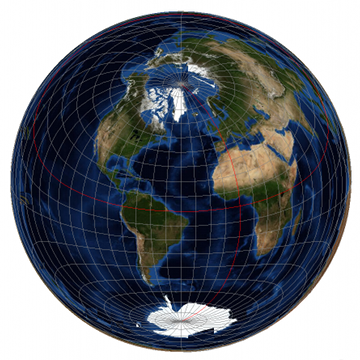
Sample code
 ILcdProjection projection =
     new TLcdLambertAzimuthalEqualArea(20.0, -40.0);
Implementation aspects
The equations of the lambert azimuthal equal-area projection are taken from [Snyder1987].
Limitations
Only the spherical form of the projection is implemented. See
TLcdEllipsoidalLambertAzimuthalEqualAreafor an implementation that uses ellipsoidal calculations.
-
-
Field Summary
-
Fields inherited from class com.luciad.projection.ALcdProjection
fPropertyChangeDispatcher
-
Fields inherited from interface com.luciad.projection.ILcdProjection
EPSILON
-
-
Constructor Summary
Constructors Constructor and Description TLcdLambertAzimuthalEqualArea()Constructs a lambert azimuthal equal-area projection with the origin at a point(0.0, 0.0).TLcdLambertAzimuthalEqualArea(double aLongitude, double aLatitude)Constructs a lambert azimuthal equal-area projection with the origin at a point(aLatitude, aLongitude).TLcdLambertAzimuthalEqualArea(ILcdPoint aOrigin)Constructs a lambert azimuthal equal-area projection with the origin at anILcdPointaOrigin.
-
Method Summary
All Methods Instance Methods Concrete Methods Modifier and Type Method and Description double[][]boundaryLats(double lon)Default implementation.double[][]boundaryLons(double lat)Default implementation.protected voidcalculateCachedValues()Constants based on the point of origin of the projection don't have to be recalculated every time a method is called.booleaninLonLatBounds(ILcdPoint aLLHP)Checks if anILcdPointis inside the valid area of geodetic coordinates of the projection.booleaninWorldBoundsOnSphere(ILcdPoint aXYPoint, double aRadius)Checks if aILcdPointis inside the valid cartesian area of the projection.booleanisAllInBounds()If all geodetic coordinates (l ,j ) are projected (visible) by anILcdProjectionand all (x,y ) coordinates are bounded this istrue.voidlonlatheight2worldOnSphereSFCT(ILcdPoint aLLHP, double aRadius, ILcd2DEditablePoint aWorldPoint)Transforms anILcd2DEditablePointon a sphere into the cartesian coordinate system of the projection.StringtoString()Returns theStringrepresentation of the lambert azimuthal equal-area projection.voidworld2DEditableBoundsOnSphereSFCT(double aRadius, ILcd2DEditableBounds aWorldBound)The whole earth globe is projected except the point opposite the origin.voidworld2lonlatOnSphereSFCT(ILcdPoint aXYPoint, double aRadius, ILcd2DEditablePoint aLLPSFCT)Transforms anILcdPointfrom the cartesian coordinate system of the projection into anILcd2DEditablePointonto a sphere.-
Methods inherited from class com.luciad.projection.ALcdAzimuthal
clone, equals, getOrigin, getOriginLat, getOriginLon, hashCode, isContinuous, loadProperties, setOriginLat, setOriginLon, writePropertiesSFCT
-
Methods inherited from class com.luciad.projection.ALcdProjection
addPropertyChangeListener, firePropertyChangeEvent, inWorldBoundsOnEllipsoid, lonlatheight2worldOnEllipsoidSFCT, removePropertyChangeListener, world2DEditableBoundsOnEllipsoidSFCT, world2lonlatOnEllipsoidSFCT
-
Methods inherited from class java.lang.Object
finalize, getClass, notify, notifyAll, wait, wait, wait
-
Methods inherited from interface com.luciad.projection.ILcdProjection
inWorldBoundsOnEllipsoid, lonlatheight2worldOnEllipsoidSFCT, world2DEditableBoundsOnEllipsoidSFCT, world2lonlatOnEllipsoidSFCT
-
Methods inherited from interface com.luciad.util.ILcdPropertyChangeSource
addPropertyChangeListener, removePropertyChangeListener
-
-
-
-
Constructor Detail
-
TLcdLambertAzimuthalEqualArea
public TLcdLambertAzimuthalEqualArea()
Constructs a lambert azimuthal equal-area projection with the origin at a point(0.0, 0.0).
-
TLcdLambertAzimuthalEqualArea
public TLcdLambertAzimuthalEqualArea(double aLongitude,
                                     double aLatitude)
Constructs a lambert azimuthal equal-area projection with the origin at a point(aLatitude, aLongitude). The central meridian is at the longitudeaLongitude.- Parameters:
aLongitude- longitude of the origin of the projection, in decimal degrees.aLatitude- latitude of the origin of the projection, in decimal degrees.
-
TLcdLambertAzimuthalEqualArea
public TLcdLambertAzimuthalEqualArea(ILcdPoint aOrigin)
Constructs a lambert azimuthal equal-area projection with the origin at anILcdPointaOrigin. The central meridian is ataOrigin.getX().- Parameters:
aOrigin-ILcdPointof the origin of the projection.aOriginis cloned within the constructor, so no side effects will happen to the projection as a result from changes toaOrigin.
-
-
Method Detail
-
calculateCachedValues
protected void calculateCachedValues()
Description copied from class:ALcdAzimuthalConstants based on the point of origin of the projection don't have to be recalculated every time a method is called. They only have to be calculated when the projection properties change. Within the methods the pre-calculated values then can be used in order to gain efficiency.- Overrides:
calculateCachedValuesin classALcdAzimuthal
-
isAllInBounds
public boolean isAllInBounds()
Description copied from interface:ILcdProjectionIf all geodetic coordinates (l ,j ) are projected (visible) by anILcdProjectionand all (x,y ) coordinates are bounded this istrue. AllILcdProjectionobjects have bounded (x,y ) coordinates because the projection is cut off if necessary.- Returns:
trueif all LonLatPoints are within the bounds of the projection,falseotherwise.
-
lonlatheight2worldOnSphereSFCT
public void lonlatheight2worldOnSphereSFCT(ILcdPoint aLLHP,
                                           double aRadius,
                                           ILcd2DEditablePoint aWorldPoint)
                                    throws TLcdOutOfBoundsException
Description copied from interface:ILcdProjectionTransforms anILcd2DEditablePointon a sphere into the cartesian coordinate system of the projection.- Parameters:
aLLHP- point to be projected.aRadius- radius of the sphere (meters).aWorldPoint- projected point as side effect.- Throws:
TLcdOutOfBoundsException- If theILcdPointaLLHPis not within the valid area of the projection (visible area), then this exception is thrown.
-
world2lonlatOnSphereSFCT
public void world2lonlatOnSphereSFCT(ILcdPoint aXYPoint,
                                     double aRadius,
                                     ILcd2DEditablePoint aLLPSFCT)
                              throws TLcdOutOfBoundsException
Description copied from interface:ILcdProjectionTransforms anILcdPointfrom the cartesian coordinate system of the projection into anILcd2DEditablePointonto a sphere.- Parameters:
aXYPoint- projected point for which the corresponding geodetic point is sought.aRadius- radius of the sphere (meters).aLLPSFCT- resulting geodetic coordinate as side effect.- Throws:
TLcdOutOfBoundsException- If theILcdPointaXYPointis not within the valid area of the projection (visible area), then this exception is thrown.
-
inLonLatBounds
public boolean inLonLatBounds(ILcdPoint aLLHP)
Description copied from interface:ILcdProjectionChecks if anILcdPointis inside the valid area of geodetic coordinates of the projection. The valid area is determined by the LonLatPoints that are visible and for which the corresponding cartesian coordinate is within the boundaries.- Parameters:
aLLHP-ILcdPointto be checked upon.- Returns:
trueif valid,falseif invalid.
-
boundaryLons
public double[][] boundaryLons(double lat)
Description copied from class:ALcdProjectionDefault implementation. To be redefined for specific projections.- Specified by:
boundaryLonsin interfaceILcdProjection- Overrides:
boundaryLonsin classALcdProjection- Parameters:
lat- latitude in decimal degrees and -90.0 <=aLat<= 90.0.- Returns:
- the array of pairs of longitudes[0] and longitudes[1], where the closed interval longitudes[0] -> longitudes[1] is in visible area and -180.0 <= lon[i] <= 180.0.
-
boundaryLats
public double[][] boundaryLats(double lon)
Description copied from class:ALcdProjectionDefault implementation. To be redefined for specific projections.- Specified by:
boundaryLatsin interfaceILcdProjection- Overrides:
boundaryLatsin classALcdProjection- Parameters:
lon- longitude in decimal degrees -180.0 <= lon <= 180.0 .- Returns:
- the array of pairs of latitudes lats[0] and lats[1], where the closed interval lats[0] -> lats[1] is in visible area and -90.0 <= lats[i] <= 90.0 .
-
world2DEditableBoundsOnSphereSFCT
public void world2DEditableBoundsOnSphereSFCT(double aRadius,
                                              ILcd2DEditableBounds aWorldBound)
The whole earth globe is projected except the point opposite the origin.- Parameters:
aRadius- radius of the sphere.aWorldBound- the bounds of the projection in world coordinates as side effect.
-
inWorldBoundsOnSphere
public boolean inWorldBoundsOnSphere(ILcdPoint aXYPoint,
                                     double aRadius)
Description copied from interface:ILcdProjectionChecks if aILcdPointis inside the valid cartesian area of the projection. The valid cartesian area is determined naturally by the projection bounds or by an artificial introduced boundary limit because some cartesian points are at infinity. The shape of the valid cartesian area is in many cases rectangular or circular although it might be more complex.- Parameters:
aXYPoint- point to be checked upon.aRadius- radius of the sphere.- Returns:
trueif valid,falseif invalid.
-
toString
public String toString()
Returns theStringrepresentation of the lambert azimuthal equal-area projection.- Specified by:
toStringin interfaceILcdProjection- Overrides:
toStringin classObject- Returns:
- the
Stringrepresentation of the lambert azimuthal equal-area projection.
-
-